
TURKEY-EU RELATIONS ON THE 50TH ANNIVERSARY OF THE ANKARA AGREEMENT
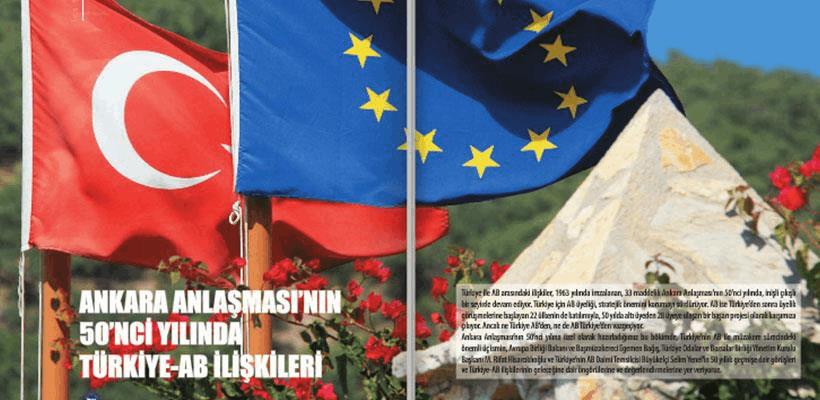
An article written by Minister for EU Affairs and Chief Negotiator Egemen Bagis regarding the fiftieth anniversary of the Ankara Agreement has been published in the 184th issue of the IKV Magazine of Economic Development Foundation, dated September 2013.
The following paragraphs are from this article:
“The date 12 September 1963 on which the Ankara Agreement establishing the legal basis of our relations with EU was signed, has been mostly overshadowed by the coup of 12 September. However, our Government, with the referendum realised on 12 September 2010 regarding the amendments to the Constitution, demonstrated that Turkey was now in a process in which new coups were out of the question and that it would never turn back in its journey of democratization. The EU process is no doubt the most significant impetus of Turkey’s journey towards advanced democracy. The reforms determinedly carried out by our Government in the past eleven years have brought Turkey even closer to EU standards. However, these steps have clearly not been afforded the recognition they deserved by the EU. Unfortunately, double standards and the political blockages some Member States, apparently trapped in day to day political calculations, have been applying to Turkey prevent the accession negotiations from proceeding on the right course.
This much is quite clear now. Turkey-EU relations can no longer proceed with delaying tactics, day to day political calculations and various excuses. The time has arrived for the EU to reconsider its theses and prejudices on Turkey, along with its point of view regarding our country.
Whereas Turkey today is no longer the country it was in 1963, the EU is no more the organization which consisted of only six countries. From the signing of the Ankara Agreement to this day, Turkey has gone through a significant transformation in every area and has become a much more democratic, modern, stable and powerful country, in particular through the momentum provided by the EU harmonisation process. The number of universities in our country, which was fourteen in 1963, is 200 today. Whereas our income per capita was $400 in 1963, it has increased to approximately $11.000 as of 2012, which is greater than most EU Member States. Turkey is currently the sixth largest economy in Europe and the sixteenth in the world.
The EU has continued with enlargement and deepening simultaneously, and with 28 Members today, has become a significant political Union that goes beyond economic integration. Currently, while the EU is struggling with economic crisis, it is also fighting against increasing racism, Islamophobia and xenophobia. Furthermore, far from being an influential actor in the area of foreign policy, the EU is currently projecting an image which is damaging to its credibility in international platforms.
A similar erosion of credibility is unfortunately in question regarding Turkey-EU relations. Double standards that have been applied to Turkey during the negotiation process continue to undermine our citizens’ confidence in the credibility of the EU. The visa regime applied to Turkey, a consequence of the 1980 coup, continues to be the biggest problem faced by our citizens. Furthermore, the accessions negotiations are not able to progress on a fair basis. The negotiations are obstructed by artificial blockages based on political considerations. Surprisingly, whereas the EU criticizes Turkey severely in the areas of freedom of expression and fundamental rights in the Progress Reports, it is also reluctant to open chapters significant in terms of the democratisation of Turkey, such as Chapter 23 and 24. It is a contradiction for the EU not to open these two chapters, which was due to the unilateral veto by the Southern Greek Cypriot Administration.
In retrospective, there are many lost opportunities in terms of Turkey-EU relations in the period of 50 years onwards from the signing of the Ankara Agreement. However, as we often say, the process itself is much more important than the result. The gains from the EU accession process are our most important motivation. The EU process is the anchor of the reforms in Turkey. Attaining the highest level of welfare for our people is the most important reason for our wish to be a part of the EU, which we consider to be the most successful project in the world.
Turkey has already taken its place among the most important 21st century actors with the reforms and other work that has been carried out since the day our Government took office.
As we express on every occasion, the EU accession process should be viewed as a “win-win” situation for both sides. What stands to be gained in the framework of Turkey-EU relations is much too valuable and strategically significant to become instrumental only to the interests of certain circles bereft of vision. We continue on our EU journey with this mentality, with the same confidence, courage and dedication. We say “Don’t stop, keep on with the reforms”.
One cannot confine ideas and dreams to enclosed spaces. The EU peace project is not and cannot be a project that is limited to a single continent, religion or language. Without Turkey, the EU will always remain incomplete. Turkey is an opportunity for the EU to break out of its shell today and to become globalised. Furthermore, the EU is an important guide for Turkey in terms of the objectives of advanced democracy. Thus, the best way for all is to combine their strengths in the framework of the “win-win” principle. Certainly, Turkey could proceed without the EU. The EU would also be able to proceed, albeit more slowly, without Turkey. However, a way on which Turkey and EU proceed together would be much brighter one. Most of all, a common road that Turkey and EU walk on together for world peace will bring hope to and revive the enthusiasm of the rest of the world.
İKV Dergisi
Kaynak:
http://www.ikv.org.tr/ikv_dergi/ikv_eylul_2013/html/index.html
