
TURKEY’ S EU PERSPECTIVE AND THE MEDIA
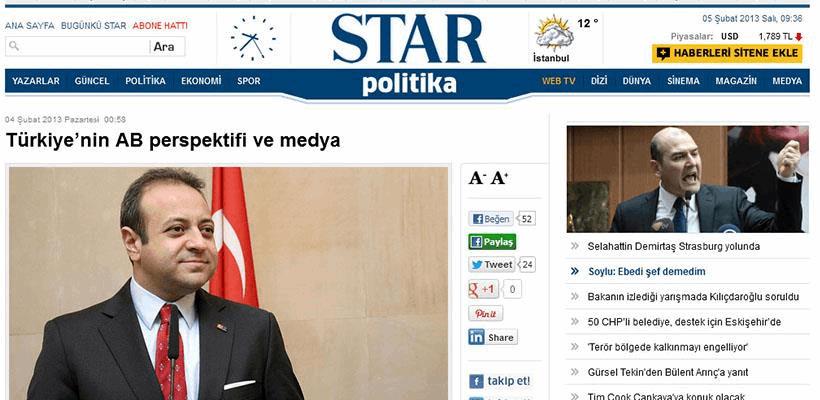
An article written by the Minister for EU Affairs and Chief Negotiator, Egemen Bagis, titled “Turkey’s EU Perspective and the Media” was published in the Star Newspaper.
Egemen Bagis indicated the following in his article, in which he described the process of change and improvement in the Turkish media through the reforms realized in Turkey-EU integration process:
“We observe that the media is now among the determining aspects of the global order in a period in which the world is going through a significant process of change and the effects of the global crisis still continue. In fact, the invention of television had an effect significant to the extent that it started a new age in the world history.
As is known, one of the first television images that people saw with the invention of television was “Felix the Cat”.
It is an interesting coincidence that in 2012, nearly one century later, the name of the person who for the first time jumped from a distance of 39 km. to the earth should be Felix.
This coincidence alone is a message so significant that it can describe the transformation of the world.
It is clear that there is a need in the media sector to gain a new outlook and present a new perspective to the public as a part of this transformation.
Turkey has achieved significant progress in terms of following and even setting the trends in the world of the media.
The most important reason for the progress attained by the Turkish media is undoubtedly the determination of our government to take firm stance on democracy and the fundamental freedoms and to establish new horizons and a new vision in the areas of science and technology in the last decade.
Turkey is no longer a country led by an understanding set by black-white TV broadcasts on one channel. Turkey has developed a much more colorful and polyphonic, as well as a stronger, more diverse and freer, media atmosphere through the reforms pursued determinedly in the EU accession process.
I believe that we need to particularly stress the relationship between the media and democracy.
Although we are going through a period in which “the wheat is not being separated from the chaff” in terms of freedom of media, Turkey has experienced a period in which the boldest steps for freedom without compromise has been taken by our Government.
When Turkey-EU integration process started in 1959, television broadcasts did not even exist in our country. Thankfully, with the contribution of this process, digital broadcasts are accessible in all our cities and the democratic atmosphere of our country is enlivened by television and TV channels.
Today there are more than 2700 newspapers, 3000 journals, 250 TV channels and over one thousand radios in Turkey.
The TRT public television channels alone broadcast in 35 different languages through fourteen different channels. One of these channels broadcasts in Kurdish for 24 hours a day.
It is the people who own the remote control device.
The relationship between the media and democracy has never been clearly and definitely separated; it has always been an issue of discussion.
The Scottish philosopher, historian and economist James Mill conceptualized the “Watchdog” function of the media in a democracy; when the British statesman Edmund Burke, pointing to the journalists beside him in Parliament, said “Here is the fourth force sitting over there, the most important one among them all”, he introduced the concept of “fourth force” into the literature.
The late Robert Maxwell, the owner of the Mirror group, also made the following meaningful statement: “I invested 90 million pounds in this business and I did not do so just to be blessed.”
It would be out of the question to refer to the media in Turkey independent of these discussions.
When the media became an instrument which controlled or was controlled, it was Turkey and the Turkish people who paid the price.
The best way would be to adopt the principle that it is really the people who own the remote control device.
Military coups and the media
The periods of military coups in Turkey are significant examples of the relationship between the media and democracy. The media has always played the leading role as one of the most powerful instruments of the coups.
On the other hand, the media, which was used as an instrument of the coup, was ironically also a victim of these coups.
For instance, Turkey’s 1980 military coup…
It is known that the environment for the coup had been prepared by means of the media. However, the figures in terms of the cost of the coup for the media are remarkable.
A total of 4000 years imprisonment for 400 journalists was sought due to the 1980 coup. The journalists were sentenced to a total of 300, 315 years and 6 months. The total indemnity payment demanded from journalists was 12 billion 848 million liras. 31 journalists were imprisoned, 300 journalists were attacked, three journalists were murdered; the press could not publish for 300 days. 303 cases were filed against 13 major newspapers and 39 tons of newspapers and journals were destroyed.
The EU Process and the Media
Thankfully, today we have left those days behind.
Now in Turkey the military coup periods have ended. Today, the steps we have taken ensure that the concept of a coup has also fallen into disuse in our country in the future. The EU process has doubtless significantly contributed to this.
Today, the pages of newspapers have become much more colorful as a result of our reforms in the EU accession process.
In addition, the informative nature of the media has made it one of the most important aspects of our EU accession process.
For this reason, we exchange ideas and knowledge with our media representatives from international, national, regional and local levels during this process in order to more accurately inform our media and public.
Without gaining the support of and accurately informing the public, it would not be possible to carry out the EU accession process soundly on the necessary basis and successfully manage this process.
Unfortunately, we know that previous governments have misled the Turkish people and Turkish media regarding the EU, painting a promising picture of this process.
Our people have not forgotten the headline: “We will become a full member of the EU in 1998 at the latest.” During that period, many newspapers even reported Turkey’s application to the Community as if we had already became a full member in their headlines.
When the AK Party came into power, it assumed a clear and determined stance on the EU process by ending this hope mongering and received a date to start negotiations from the EU within two years; Turkey started negotiations on October 3, 2005.
Thus, headlines “We were refused but we stand tall” of many years changed to “We stood firm and succeeded.”
These successes achieved with the reforms have advanced Turkey to the point that it can ease the burden of the EU rather than be a burden. Falling back from this point is out of the question.
Turkey’s EU membership is the most important opportunity to raise again the ratings of the EU.
Source: http://haber.stargazete.com/politika/turkiyenin-ab-perspektifi-ve-medya/haber-724768
